The Swimming Hour Cover Art Hope Theres Someone Cover Art
| Keith Moon | |
|---|---|
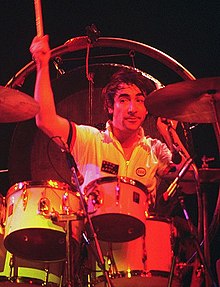 Moon in 1975 | |
| Born | Keith John Moon (1946-08-23)23 August 1946 Wembley, England |
| Died | 7 September 1978(1978-09-07) (anile 32) London, England |
| Cause of death | Drug overdose |
| Burying place | Golders Green Crematorium London, England |
| Occupation | Musician |
| Spouse(s) | Kim Kerrigan (g. 1966; div. 1975) |
| Partner(s) | Annette Walter-Lax (1975–1978; his expiry) |
| Children | 1 |
| Musical career | |
| Genres |
|
| Instruments |
|
| Years active | 1962–1978 |
| Associated acts | The Who |
Keith John Moon (23 August 1946[2] – seven September 1978) was an English drummer for the rock band the Who. He was noted for his unique style of playing and his eccentric, often self-destructive behaviour and addiction to drugs and alcohol.
Moon grew up in Alperton, a suburb of Wembley, in Middlesex, and took up the drums during the early on 1960s. Afterwards playing with a local band, the Beachcombers, he joined the Who in 1964 before they recorded their first unmarried. Moon was recognised for his drumming style, which emphasised tom-toms, cymbal crashes, and drum fills. Throughout Moon'due south tenure with the Who, his drum kit steadily grew in size, and (along with Ginger Baker) he has been credited every bit one of the earliest rock drummers to regularly employ double bass drums in his setup. Moon occasionally collaborated with other musicians and after appeared in films, but considered playing in the Who his primary occupation, and remained a fellow member of the ring until his death. In improver to his talent as a drummer, Moon adult a reputation for neat his kit on phase and destroying hotel rooms on tour. He was fascinated with blowing up toilets with cherry bombs or dynamite, and destroying television sets. Moon enjoyed touring and socialising, and became bored and restless when the Who were inactive. His 21st birthday party in Flint, Michigan, has been cited every bit a notorious example of decadent behaviour by stone groups.
Moon suffered a number of setbacks during the 1970s, most notably the accidental death of chauffeur Neil Boland and the breakdown of his marriage. He became addicted to alcohol, particularly brandy and champagne, and acquired a reputation for decadence and dark humour; his nickname was "Moon the Loon". After moving to Los Angeles with personal assistant Peter "Dougal" Butler during the mid-1970s, Moon recorded his only solo album, the poorly received Two Sides of the Moon. While touring with the Who, on several occasions he passed out on stage and was hospitalised. By the fourth dimension of their final tour with him in 1976, and particularly during product of The Kids Are Alright and Who Are Yous, the drummer's deterioration was axiomatic. Moon moved back to London in 1978, dying in September of that year from an overdose of Heminevrin, a drug intended to treat or preclude symptoms of alcohol withdrawal.
Moon's drumming continues to be praised by critics and musicians. He was posthumously inducted into the Mod Drummer Hall of Fame in 1982, becoming the second rock drummer to be chosen, and in 2011, Moon was voted the second-greatest drummer in history by a Rolling Stone readers' poll.[iii] [iv]
Early life [edit]

Keith John Moon was born to Alfred Charles (Alf) and Kathleen Winifred (Kit) Moon[2] [5] on 23 Baronial 1946 at Key Middlesex Infirmary in northwest London, and grew up in Wembley. He was hyperactive as a boy, with a restless imagination and a detail fondness for The Goon Show and music. Moon attended Alperton Secondary Modern Schoolhouse after failing his eleven plus test, which precluded his attending a grammar school.[6] His art teacher said in a report: "Retarded artistically. Idiotic in other respects". His music teacher wrote that Moon "has slap-up ability, but must guard against a trend to show off."[vii]
Moon joined his local Sea Buck Corps ring at the historic period of twelve on the bugle, but establish the instrument too hard to learn and decided to take up drums instead.[8] He was interested in practical jokes and home science kits, with a particular fondness for explosions.[ix] On his style home from schoolhouse, Moon would often go to Macari'south Music Studio on Ealing Road to practice on the drums in that location, learning his basic skills on the instrument. He left school at historic period xiv, around Easter in 1961.[ten] Moon then enrolled at Harrow Technical College; this led to a chore as a radio repairman, enabling him to buy his first drum kit.[xi]
Career [edit]
Early years [edit]
Moon took lessons from i of the loudest contemporary drummers, Screaming Lord Sutch's Carlo Little, at ten shillings per lesson.[12] Moon's early fashion was influenced by jazz, American surf music and rhythm and blues, exemplified by noted Los Angeles studio drummer Hal Blaine. His favourite musicians were jazz artists, particularly Gene Krupa (whose flamboyant style he subsequently copied).[13] Moon too admired Elvis Presley's original drummer DJ Fontana, the Shadows' original drummer Tony Meehan[14] and the Pretty Things' Viv Prince.[15] He also enjoyed singing, with a particular interest in Motown.[16] Moon idolised the Embankment Boys;[17] Roger Daltrey later said that given the opportunity, Moon would take left to play for the California band fifty-fifty at the peak of the Who's fame.[xviii]
During this time Moon joined his get-go serious band: the Escorts, replacing his best friend Gerry Evans.[xix] In Dec 1962 he joined the Beachcombers, a semi-professional London cover band playing hits by groups such every bit the Shadows.[20] During his fourth dimension in the group Moon incorporated theatrical tricks into his deed, including "shooting" the group's lead singer with a starter pistol.[21] The Beachcombers all had twenty-four hour period jobs; Moon, who worked in the sales section at British Gypsum, had the keenest interest in turning professional person. In Apr 1964, aged 17,[22] he auditioned for the Who as a replacement for Doug Sandom. The Beachcombers connected equally a local cover band after his divergence.[23]
The Who [edit]
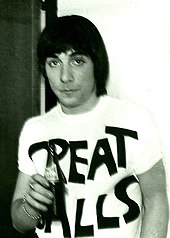
A commonly cited story of how Moon joined the Who is that he appeared at a evidence shortly after Sandom'south departure, where a session drummer was used. Dressed in ginger clothes and with his pilus dyed ginger (future bandmate Pete Townshend later described him as a "ginger vision"),[24] : 52:twoscore he claimed to his would-be bandmates that he could play ameliorate; he played in the set'southward second one-half, well-nigh demolishing the pulsate kit in the procedure.[25] In the words of the drummer, "they said go ahead, and I got backside this other guy'south drums and did one song-'Road Runner.' I'd several drinks to get me courage up and when I got onstage I went arrgggGhhhh on the drums, broke the bass drum pedal and two skins, and got off. I figured that was information technology. I was scared to death. Afterward I was sitting at the bar and Pete came over. He said: 'You ... come 'ere.' I said, mild as you delight: 'Yes, yes?' And Roger, who was the spokesman so, said: 'What are you doing next Monday?' I said: 'Nada.' I was working during the 24-hour interval, selling plaster. He said: 'Y'all'll accept to surrender work ... there's this gig on Mon. If y'all desire to come, we'll option you upwardly in the van.' I said: 'Right.' And that was it."[26] Moon later claimed that he was never formally invited to join the Who permanently; when Ringo Starr asked how he had joined the band, he said he had "just been filling in for the final fifteen years."[24] : 52:29
Moon's arrival in the Who changed the dynamics of the group. Sandom had generally been the peacemaker as Daltrey and Townshend feuded between themselves, just because of Moon'southward temperament the group now had four members frequently in conflict. "We used to fight regularly", remembered Moon in later years. "John [Entwistle] and I used to have fights – it wasn't very serious, it was more of an emotional spur-of-the moment thing."[27] Moon also clashed with Daltrey and Townshend: "We really have admittedly nothing in common autonomously from music", he said in a later interview.[28] Although Townshend described him equally a "completely unlike person to anyone I've ever met",[24] : 38:48 the pair had a rapport in the early years and enjoyed practical jokes and improvised comedy. Moon's drumming way affected the band'south musical construction; although Entwistle initially constitute Moon's lack of conventional timekeeping problematic, it created an original sound.[27]
Moon was particularly fond of touring, since it was his but chance to regularly socialise with his bandmates, and was generally restless and bored when not playing live. This later on carried over to other aspects of his life, equally he acted them out (according to journalist and Who biographer Dave Marsh) "as if his life were ane long tour."[29] These antics earned him the nickname "Moon the Loon".[30]
Musical contributions [edit]
I suppose as a drummer, I'g adequate. I've got no real aspirations to be a groovy drummer. I simply want to play drums for the Who and that's it.
—Keith Moon, Melody Maker, September 1970[31]
Moon's way of drumming was considered unique past his bandmates, although they sometimes constitute his unconventional playing frustrating; Entwistle noted that he tended to play faster or slower co-ordinate to his mood.[32] "He wouldn't play across his kit", he later added. "He'd play zig-zag. That'due south why he had 2 sets of tom-toms. He'd movement his arms forward similar a skier."[25] Daltrey said that Moon "only instinctively put pulsate fills in places that other people would never have thought of putting them."[25]
Who biographer John Atkins wrote that the grouping's early test sessions for Pye Records in 1964 show that "they seemed to have understood just how important was ... Moon'southward contribution."[33] Gimmicky critics questioned his ability to keep fourth dimension, with biographer Tony Fletcher suggesting that the timing on Tommy was "all over the identify." Who producer Jon Astley said, "Y'all didn't think he was keeping time, but he was."[32] Early recordings of Moon'due south drumming sound tinny and disorganised;[34] information technology was not until the recording of Who's Next, with Glyn Johns' no-nonsense production techniques and the need to keep time to a synthesizer runway, that he began developing more discipline in the studio. Fletcher considers the drumming on this album to be the best of Moon'due south career.[35]
Unlike gimmicky rock drummers such equally Ginger Baker and John Bonham, Moon hated drum solos and refused to play them in concert. At a Madison Square Garden show on ten June 1974, Townshend and Entwistle decided to spontaneously stop playing during "Waspman" to listen to Moon's drum solo. Moon connected briefly and and then stopped, shouting "Drum solos are boring!"[36] On 23 June 1977, he made a guest advent at a Led Zeppelin concert in Los Angeles.[37]

Moon singing at Maple Leafage Gardens, Toronto, 21 October 1976;[38] he enjoyed singing whenever possible.
Moon besides aspired to sing lead vocal on some songs.[39] While the other three members handled near of the onstage vocals, Moon would attempt to sing fill-in (particularly on "I Can't Explain"). He provided humorous commentary during song announcements, although sound engineer Bob Pridden preferred to mute his vocal microphone on the mixing desk whenever possible.[40] Moon'southward knack for making his bandmates express mirth around the microphone led them to banish him from the studio when vocals were existence recorded; this led to a game in which Moon would sneak in to join the singing.[41] At the end of "Happy Jack", Townshend can be heard saying "I saw ya!" to Moon as he tries to sneak into the studio.[42] The drummer's involvement in surf music and his want to sing led to his performing pb vocals on several early tracks, including "Bucket T" and "Barbara Ann" (Gear up Steady Who EP, 1966)[43] and loftier backing vocals on other songs, such as "Pictures of Lily". Moon'south performance on "Bell Boy" (Quadrophenia, 1973) saw him abandon "serious" song performances to sing in character, which gave him (in Fletcher's words) "full licence to live upward to his reputation as a lecherous drunk"; information technology was "exactly the kind of performance the Who needed from him to bring them back down to earth."[44]
Moon composed "I Need Y'all", the instrumental "Cobwebs and Strange" (from the album A Quick One, 1966),[45] the single B-sides "In The City" (co-written with Entwistle)[46] and "Daughter'due south Eyes" (from The Who Sell Out sessions featured on Thirty Years of Maximum R&B and a 1995 re-release of The Who Sell Out), "Dogs Part Two" (1969), "Tommy'southward Holiday Camp" (1969)[47] and "Waspman" (1972).[48] Moon likewise co-composed "The Ox" (an instrumental from their debut album, My Generation) with Townshend, Entwistle and keyboardist Nicky Hopkins. The setting for "Tommy's Holiday Camp" (from Tommy) was credited to Moon;[49] the vocal was primarily written by Townshend and, although there is a misconception that Moon sings on it, the anthology version is Townshend's demo.[fifty]
The drummer produced the violin solo on "Baba O'Riley".[51] Moon saturday in on congas with East of Eden at London's Lyceum Ballroom, and afterwards suggested to violinist Dave Arbus that he play on the rail.[52]
Equipment [edit]

Premier'southward replica of the "Pictures of Lily" drum kit, which Moon used from 1967 to 1969[53]
Moon played a 4- and later a 5-slice drum kit during his early on career. During much of 1964 and 1965 his setups consisted of Ludwig drums and Zildjian cymbals. He began to endorse Premier Drums in late 1965, and remained a loyal customer of the company.[54] His start Premier kit was in red sparkle and featured ii high toms. In 1966 Moon moved to an fifty-fifty larger kit,[55] merely without the customary hi-hat—at the time he preferred keeping ride rhythms with ride and crash cymbals, but he later on reinstated the hi-hats.[56] His new larger configuration was notable for the presence of two bass drums; he, forth with Ginger Baker, has been credited every bit i of the early pioneers of double bass drumming in rock.[57] This kit was not used at the Who's performance at the 1967 Monterey Pop Festival.[58] From 1967 to 1969 Moon used the "Pictures of Lily" drum kit (named for its artwork), which had two 22-inch (56 cm) bass drums, two xvi-inch (41 cm) floor toms and three mounted toms.[53] In recognition of his loyalty to the visitor, Premier reissued the kit in 2006 as the "Spirit of Lily".[54]
By 1970 Moon had begun to use timbales, gongs and timpani, and these were included in his setup for the remainder of his career.[53] In 1973 Premier's marketing manager, Eddie Haynes, began consulting Moon about specific requirements.[58] At i bespeak, Moon asked Premier to make a white kit with aureate-plated fittings. When Haynes said that it would be prohibitively expensive, Moon replied: "Dear boy, do exactly as you feel it should be, only that's the way I desire it." The kit was somewhen fitted with copper fittings[58] and later given to a young Zak Starkey.[59]
Destroying instruments and other stunts [edit]
At an early show at the Railway Tavern in Harrow, Townshend smashed his guitar after accidentally breaking it. When the audience demanded he exercise it over again, Moon kicked over his pulsate kit.[threescore] Subsequent alive sets culminated in what the band afterwards described as "automobile-subversive fine art", in which band members (peculiarly Moon and Townshend) elaborately destroyed their equipment. Moon developed a habit of kick over his drums, challenge that he did so in exasperation at an audience'south indifference.[61] Townshend afterward said, "A fix of skins is virtually $300 [so £96] and afterwards every bear witness he'd only go bang, bang, bang and then kick the whole thing over."[62]
In May 1966, Moon discovered that the Embankment Boys' Bruce Johnston was visiting London. Later on the pair socialised for a few days, Moon and Entwistle brought Johnston to the set up of Ready Steady Go!,[63] which fabricated them tardily for a show with the Who that evening. During the finale of "My Generation", an atmospherics bankrupt out on stage between Moon and Townshend which was reported on the front folio of the New Musical Express the following week. Moon and Entwistle left the Who for a calendar week (with Moon hoping to join the Animals or the Nashville Teens), but they inverse their minds and returned.[64]
On the Who'southward early United states package tour at the RKO 58th Street Theatre in New York in March and April 1967, Moon performed two or three shows a day, kicking over his drum kit after every show.[65] Later that year, during their advent on The Smothers Brothers One-act Hour, he bribed a stagehand to load gunpowder into one of his bass drums; the stagehand used about ten times the standard corporeality.[66] During the finale of "My Generation", he gear up off the charge. The intensity of the explosion singed Townshend's pilus and embedded a piece of cymbal in Moon's arm.[67] A clip of the incident became the opening scene for the pic The Kids Are Alright.[24] : 7:44
Although Moon was known for kick over his drum kit, Haynes claimed that information technology was done carefully and the kit rarely needed repairs. Still, stands and human foot pedals were oftentimes replaced; the drummer "would go through them like a knife through butter".[58]
Other work [edit]
Music [edit]

Advertising for "Don't Worry Baby", 1974
While Moon mostly said he was only interested in working with the Who,[31] he participated in outside musical projects. In 1966 he worked with Yardbirds guitarist Jeff Brook, pianist Nicky Hopkins and future Led Zeppelin members Jimmy Page and John Paul Jones on the instrumental "Beck's Bolero", which was the B-side to "Howdy Ho Argent Lining" and appeared on the album Truth. Moon also played timpani on another rail, a cover of Jerome Kern's "Ol' Human River". He was credited on the anthology as "You Know Who".[68]
Moon may have inspired the name for Led Zeppelin. When he briefly considered leaving the Who in 1966, he spoke with Entwistle and Page near forming a supergroup. Moon (or Entwistle) remarked that a particular proffer had gone downward like a "lead zeppelin" (a play on "lead balloon"). Although that supergroup was never formed, Page remembered the phrase and later adapted it every bit the proper name of his new ring.[69]
The Beatles became friends with Moon, and this led to occasional collaborations. In 1967, he contributed bankroll vocals to "All Yous Need Is Beloved".[70] On 15 Dec 1969, Moon joined John Lennon'southward Plastic Ono Band for a alive performance at the Lyceum Theatre in London for a UNICEF charity concert. In 1972 the functioning was released as a companion disc to Lennon and Ono's album Some Fourth dimension in New York City.[71]
Moon'southward friendship with Entwistle led to an appearance on Smash Your Caput Confronting the Wall, Entwistle's first solo anthology and the commencement by a member of the Who. Moon did not play drums on the album; Jerry Shirley did, with Moon providing percussion.[72] Rolling Stone 's John Hoegel appreciated Entwistle's determination non to let Moon pulsate, saying that it distanced his anthology from the familiar sound of the Who.[73]
Moon became involved in solo work when he moved to Los Angeles during the mid-1970s. Rails Records-MCA released a Moon solo single in 1974, comprising cover versions of the Beach Boys' "Don't Worry, Babe" and "Teenage Idol". The following year he released his only solo album, entitled Two Sides of the Moon. Although it featured Moon on vocals, he played drums on only three tracks; most of the drumming was left to others (including Ringo Starr, session musicians Curly Smith and Jim Keltner, and actor-musician Miguel Ferrer).[74] The album was received poorly by critics. New Musical Express 's Roy Carr wrote, "Moonie, if y'all didn't take talent, I wouldn't care; but you have, which is why I'm not nearly to have Ii Sides of the Moon."[75] Dave Marsh, reviewing the album in Rolling Stone, wrote: "There isn't any legitimate reason for this album's beingness."[76] During ane of his few televised solo drum performances (for ABC's Wide World), Moon played a v-infinitesimal drum solo dressed as a cat on transparent acrylic drums filled with water and goldfish. When asked by an audience member what would happen to the kit, he joked that "even the best drummers go hungry."[77] His performance was non appreciated by beast lovers, several of whom called the station with complaints.[77]
Film [edit]
In the 2007 documentary film Astonishing Journey: The Story of The Who, Daltrey and Townshend reminisced about Moon'due south talent for dressing every bit (and embodying) a diverseness of characters. They remembered his dream of getting out of music and becoming a Hollywood film role player,[xvi] [ ameliorate source needed ] although Daltrey did not think Moon had the patience and work ethic required by a professional person actor. Who director Bill Curbishley agreed that Moon "wasn't disciplined enough to actually plough up or commit to doing the stuff."[78]
However, the drummer landed several acting roles. His first was in 1971, a cameo in Frank Zappa'south 200 Motels every bit a nun agape of dying from a drug overdose. Although it simply took thirteen days to film, fellow cast member Howard Kaylan remembers Moon spending off-camera time at the Kensington Garden Hotel bar instead of sleeping.[79] Moon's adjacent motion-picture show part was J.D. Clover, drummer for the fictional Stormy Tempest (played by Billy Fury) at a vacation military camp during the early on days of British rock 'north' roll, in 1973's That'll Exist the Day.[80] He reprised the role for the film's 1974 sequel, Stardust,[81] in Jim MacLaine's (David Essex) backing band the Stray Cats and played Uncle Ernie in Ken Russell'due south 1975 pic adaptation of Tommy.[82] Moon's last motion-picture show appearance was in 1978's Sextette.[83]
Destructive behaviour [edit]
When you've got money and you practice the kind of things I get up to, people express joy and say that you lot're eccentric, which is a polite way of saying y'all're fucking mad.
—Keith Moon[84]
Moon led a destructive lifestyle. During the Who's early days he began taking amphetamines,[85] and in a NME interview said his favourite food was "French Blues".[86] He spent his share of the band's income rapidly, and was a regular at London clubs such as the Speakeasy (where manager Roy Flynn recalls having to throw him out on three occasions[87]) and The Purse O'Nails; the combination of pills and alcohol escalated into alcoholism and drug addiction later in his life.[88] "[Nosotros] went through the same stages everybody goes through – the encarmine drug corridor", he after reflected. "Drinking suited the group a lot better."[89]
According to Townshend, Moon began destroying hotel rooms when the Who stayed at the Berlin Hilton on tour in late 1966.[90] In addition to hotel rooms, Moon destroyed friends' homes and even his ain, including throwing piece of furniture from upper-storey windows. Andrew Neill and Matthew Kent estimated that his destruction of hotel toilets and plumbing price as much as £300,000 ($500,000).[91] These acts, often fuelled by drugs and booze, were Moon's way of demonstrating his eccentricity; he enjoyed shocking the public with them. Longtime friend and personal assistant Butler observed, "He was trying to make people laugh and be Mr Funny, he wanted people to love him and relish him, but he would go so far. Similar a train ride yous couldn't stop."[92]
In a limousine on the way to the airport, Moon insisted they return to their hotel, saying "I forgot something." At the hotel he ran back to his room, grabbed the television set and threw information technology out of the window into the swimming puddle below. He then jumped back into the limo, maxim "I almost forgot."[93]
Fletcher argues that the Who's lengthy break (xv December 1971 – 11 Baronial 1972) between the end of their 1971 Who'due south Next Tour and the beginning of the Quadrophenia sessions devastated Moon's health,[94] as without the rigours of lengthy shows and regular touring that had previously kept him in shape, his hard-partying lifestyle took a greater toll on his trunk. He did not keep a drum kit or practise at Tara, and began to deteriorate physically as a outcome of his lifestyle.[95] Around the same time he became a severe alcoholic, starting the day with drinks and irresolute from the "lovable boozer" he presented himself as to a "boorish drunkard".[96] David Puttnam recalled, "The drinking went from being a joke to beingness a problem. On That'll Exist the Day information technology was social drinking. By the time Stardust came round information technology was hard drinking."[97]
Exploding toilets [edit]
Moon's favourite stunt was to flush powerful explosives down toilets. According to Fletcher, Moon's toilet pyrotechnics began in 1965 when he purchased a case of 500 crimson bombs.[98] He moved from reddish bombs to M-80 fireworks to sticks of dynamite, which became his explosive of choice.[99] "All that porcelain flight through the air was quite unforgettable," Moon remembered. "I never realised dynamite was so powerful. I'd been used to penny bangers before."[98] He quickly adult a reputation for destroying bathrooms and blowing up toilets. The destruction mesmerised him, and enhanced his public paradigm as rock's premier hell-raiser. Tony Fletcher wrote that "no toilet in a hotel or irresolute room was rubber" until Moon had exhausted his supply of explosives.[98]
Townshend walked into the bathroom of Moon'southward hotel room and noticed the toilet had disappeared, with only the South-bend remaining. The drummer explained that since a ruby-red bomb was about to explode, he had thrown it downwards the toilet and showed Townshend the case of cherry bombs. "And of class from that moment on," the guitarist remembered, "we got thrown out of every hotel we ever stayed in."[100]
Entwistle recalled being close to Moon on tour and both were oft involved in bravado up toilets. In a 1981 Los Angeles Times interview he admitted, "A lot of times when Keith was blowing up toilets I was standing behind him with the matches."[101]
A hotel director called Moon in his room and asked him to lower the volume on his cassette recorder because it fabricated "besides much racket." In response the drummer asked him upwardly to his room, excused himself to go to the bathroom, put a lit stick of dynamite in the toilet and shut the bathroom door. Upon returning, he asked the manager to stay for a moment, as he wanted to explicate something. Following the explosion, Moon turned the recorder back on and said, "That, dear boy, was racket. This is the 'Oo."[102]
Flint Holiday Inn incident [edit]

Site of the former Holiday Inn in Flint, Michigan, where Moon's 21st birthday party was a notorious issue (since this picture was taken, most of the building has been demolished).
On 23 August 1967, on tour opening for Herman'southward Hermits, Moon historic what he said was his 21st birthday (although it was thought at the time to be his 20th) at a Holiday Inn in Flint, Michigan.[98] Entwistle later said, "He decided that if information technology was a publicised fact that information technology was his 21st birthday, he would be able to drinkable."[103]
The drummer immediately began drinking upon his arrival in Flint. The Who spent the afternoon visiting local radio stations with Nancy Lewis (then the band's publicist), and Moon posed for a photograph outside the hotel in forepart of a "Happy Birthday Keith" sign put up by the hotel direction. According to Lewis, Moon was drunkard by the fourth dimension the ring went onstage at Atwood Stadium.[104]
Returning to the hotel, Moon started a food fight and soon block began flying through the air. The drummer knocked out office of his front tooth; at the hospital, doctors could not give him an anaesthetic (due to his inebriation) before removing the residue of the molar. Back at the hotel a mêlée erupted; burn down extinguishers were set off, guests (and objects) thrown into the pond pool and a pianoforte reportedly destroyed. The chaos ended but when police arrived with guns drawn.[104]
A furious Vacation Inn management presented the groups with a nib for $24,000, which was reportedly settled past Herman's Hermits tour manager Edd McCann.[105] Townshend claimed that the Who were banned for life from all of the hotel's backdrop,[106] just Fletcher wrote that they stayed at a Holiday Inn in Rochester, New York, a calendar week later. He besides disputed a widely held belief that Moon collection a Lincoln Continental into the hotel'due south swimming puddle, as claimed by the drummer in a 1972 Rolling Rock interview.[105]
Passing out on stage [edit]

Moon at Maple Leaf Gardens, Toronto, 21 October 1976. By this point in his career, it was uncertain whether he could end a show without incident. Except for two informal shows filmed for The Kids are Alright, this was the drummer's final public operation with the Who.[107]
Moon's lifestyle began to undermine his health and reliability. During the 1973 Quadrophenia bout, at the Who's debut United states date at the Cow Palace in Daly City, California, Moon ingested a mixture of tranquillisers and brandy. During the concert, Moon passed out on his drum kit during "Won't Become Fooled Again". The ring stopped playing, and a group of roadies carried Moon offstage. They gave him a shower and an injection of cortisone, sending him back onstage afterward a thirty-infinitesimal filibuster.[108] Moon passed out again during "Magic Bus", and was again removed from the stage. The band continued without him for several songs earlier Townshend asked, "Can anyone play the drums? – I mean somebody good?" A drummer in the audience, Scot Halpin, came up and played the remainder of the show.[109]
During the opening engagement of the band'south March 1976 United states tour at the Boston Garden, Moon passed out over his drum kit after two numbers and the prove was rescheduled. The side by side evening Moon systematically destroyed everything in his hotel room, cut himself doing and so and passed out. He was discovered by manager Neb Curbishley, who took him to a infirmary, telling him "I'one thousand gonna become the doctor to go you squeamish and fit, and so you're back within 2 days. Because I want to break your fucking jaw ... You lot have fucked this band around then many times and I'1000 not having information technology whatsoever more."[110] Doctors told Curbishley that if he had not intervened, Moon would have bled to death.[111] Marsh suggested that at this point Daltrey and Entwistle seriously considered firing Moon, but decided that doing so would make his life worse.[112]
Entwistle has said that Moon and the Who reached their alive peak in 1975–76. At the end of the 1976 U.s.a. tour in Miami that Baronial, the drummer, delirious, was treated in Hollywood Memorial Hospital for eight days. The group was concerned that he would be unable to complete the concluding leg of the bout, which concluded at Maple Leafage Gardens in Toronto on 21 October (Moon'due south last public evidence).[107] During the band's recording breather between 1976 and 1978, Moon gained a considerable corporeality of weight.[113] By the fourth dimension of the Who's invitation-simply show at the Gaumont State Cinema on xv December 1977 for The Kids are Alright, Moon was visibly overweight and had difficulty sustaining a solid performance.[114] After recording Who Are You, Townshend refused to follow the album with a bout unless Moon stopped drinking,[115] and said that if Moon's playing did not improve he would exist fired.[116] Daltrey later denied threatening to fire him, but said that by this fourth dimension the drummer was out of control.[117]
Fiscal problems [edit]
Considering the Who's early stage act relied on smashing instruments, and attributable to Moon's enthusiasm for damaging hotels, the group were in debt for much of the 1960s; Entwistle estimated they lost nearly £150,000.[118] Even when the group became relatively financially stable later Tommy, Moon continued to rack upwards debts. He bought a number of cars and gadgets, and flirted with bankruptcy.[29] Moon's recklessness with money reduced his turn a profit from the group'due south 1975 Uk bout to £47.35 (equivalent to £406 in 2020).[119] [120]
Personal life and relationships [edit]
Birthdate [edit]
Earlier the 1998 release of Tony Fletcher'due south Dear Male child: The Life of Keith Moon, Moon's appointment of birth was presumed to be 23 August 1947. This erroneous date appeared in several otherwise-reliable sources, including the Townshend-authorised biography Earlier I Get Old: The Story of The Who.[121] The incorrect date had been supplied by Moon in interviews before it was corrected by Fletcher to 1946.[ii]
Kim Kerrigan [edit]
Moon'southward first serious human relationship was with Kim Kerrigan, whom he started dating in January 1965 later on she saw the Who play at Le Disque a Become! Go! in Bournemouth.[122] Past the end of the year she discovered she was pregnant. Her parents, who were furious, met with the Moons to discuss their options, and she moved into the Moon family home in Wembley.[123] She and Moon were married on 17 March 1966 at Brent Register Office,[124] and their daughter Amanda was born on 12 July.[125] The marriage (and child) were kept surreptitious from the printing until May 1968.[126] Moon was occasionally trigger-happy towards Kim:[127] "if nosotros went out afterward I had Mandy", she later said, "if someone talked to me, he'd lose it. We'd go habitation and he'd start a fight with me."[128] He loved Amanda, simply his absences due to touring and fondness for applied jokes fabricated their relationship uneasy when she was very young. "He had no idea how to be a male parent", Kim said. "He was as well much of a child himself."[126]
From 1971 to 1975 Moon owned Tara, a home in Chertsey where he initially lived with his married woman and daughter.[129] The Moons entertained extravagantly at domicile, and owned a number of cars. Jack McCullogh, then working for Track Records (the Who'due south label), recalls Moon ordering him to purchase a milk float to store in the garage at Tara.[130]
In 1973 Kim, convinced that neither she nor anyone else could moderate Keith's behaviour, left her married man and took Amanda;[131] she sued for divorce in 1975 and afterwards married Faces keyboard role player Ian McLagan.[132] Marsh believes that Moon never truly recovered from the loss of his family.[133] Butler agrees; despite his human relationship with Annette Walter-Lax, he believes that Kim was the only woman Moon loved.[92] McLagan commented that Moon "couldn't handle it."[134] Moon would harass them with phone calls, and on one occasion before Kim sued for divorce, he invited McLagan for a drink at a Richmond pub and sent several "heavies" to break into McLagan's abode on Fife Road and expect for Kim, forcing her to hide in a walk-in cupboard.[134] She died in a car accident in Austin, Texas, on 2 Baronial 2006.[135]
Annette Walter-Lax [edit]
In 1975 Moon began a relationship with Swedish model Annette Walter-Lax, who later said that Moon was "so sweet when he was sober, that I was just living with him in the hope that he would kick all this craziness."[84] She begged Malibu neighbour Larry Hagman to check Moon into a clinic to dry out out (every bit he had attempted to do before), but when doctors recorded Moon'due south chemical intake at breakfast – a bottle of champagne, Courvoisier and amphetamines – they concluded that there was no promise for his rehabilitation.[136]
Friends [edit]

Moon onstage in Toronto, 21 October 1976
Moon enjoyed beingness the life of the party. Beak Curbishley remembered that "he wouldn't walk into whatever room and just listen. He was an attention seeker and he had to have it."[78]
Early in the Who's career, Moon got to know the Beatles. He would bring together them at clubs, forming a peculiarly close friendship with Ringo Starr.[137] Moon after became friends with Bonzo Dog Doo-Dah Band members Vivian Stanshall and "Legs" Larry Smith, and the trio would drink and play practical jokes together. Smith remembers ane occasion where he and Moon tore apart a pair of trousers, with an cohort later looking for one-legged trousers.[138] In the early 1970s Moon helped Stanshall with his "Radio Flashes" radio testify for BBC Radio ane, filling in for the vacationing John Peel. Moon filled in for Pare in 1973'southward "A Touch of the Moon", a series of four programmes produced by John Walters.[139]
Guitarist Joe Walsh enjoyed socialising with Moon. In an interview with Guitar World magazine, he recalled that the drummer "taught me how to intermission things."[140] In 1974, Moon struck up a friendship with actor Oliver Reed while working on the pic version of Tommy.[141] Although Reed matched Moon drink for beverage, he appeared on set the side by side morning fix to perform; Moon, on the other paw, would cost several hours of filming time.[78] Reed later on said that Moon "showed me the mode to insanity."[142]
Dougal Butler [edit]
Peter "Dougal" Butler began working for the Who in 1967, becoming Moon's personal assistant the following year[143] to help him stay out of trouble. He remembers managers Kit Lambert and Chris Stamp saying, "Nosotros trust yous with Keith merely if you ever want any time off, for a holiday or some sort of rest, permit us know and we'll pay for it." Butler never took them up on the offer.[92]
He followed Moon when the drummer relocated to Los Angeles, but felt that the drug culture prevalent at the time was bad for Moon: "My job was to accept eyes in the dorsum of my caput."[143] Townshend agreed, saying that past 1975 Butler had "no influence over him whatever."[144] Although he was a loyal companion to Moon, the lifestyle eventually became as well much for him; he phoned Curbishley, maxim that they needed to movement dorsum to England or i of them might die.[92] Butler quit in 1978, and later wrote of his experiences in a book entitled Full Moon: The Astonishing Rock and Roll Life of Keith Moon.[143]
Neil Boland [edit]
On 4 January 1970 Moon accidentally killed his friend, driver and bodyguard, Neil Boland, exterior the Reddish Lion pub in Hatfield, Hertfordshire. Pub patrons had begun to set on his Bentley; Moon, drunkard, began driving to escape them and hit Boland. Later an investigation, the coroner ruled Boland's death an blow; Moon, having been charged with a number of offences, received an absolute discharge.[145]
Those shut to Moon said that he was haunted by Boland's death for the rest of his life. Co-ordinate to Pamela Des Barres, Moon had nightmares (which woke them both) virtually the incident and said he had no right to exist alive.[146]
Decease [edit]
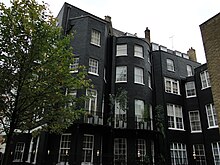
9 Curzon Square in 2012; Moon lived on the fourth floor (height left) in 1978.
In mid-1978 Moon moved into Flat 12, 9 Curzon Identify (afterward Curzon Square), Shepherd Market, Mayfair, London, renting from Harry Nilsson. Cass Elliot of the Mamas and the Papas had died at that place four years earlier, at the age of 32;[147] [148] Nilsson was concerned virtually letting the flat to Moon, assertive it was cursed. Townshend disagreed, assuring him that "lightning wouldn't strike the same place twice".[149]
Later moving in, Moon began a prescribed course of Heminevrin (clomethiazole, a sedative) to alleviate his booze withdrawal symptoms. He wanted to get sober, just considering of his fear of psychiatric hospitals he wanted to do information technology at home. Clomethiazole is discouraged for unsupervised detoxification considering of its addictive potential, its trend to induce tolerance, and its risk of death when mixed with booze.[150] The pills were prescribed past Geoffrey Dymond, a physician who was unaware of Moon's lifestyle. Dymond prescribed a bottle of 100 pills, instructing him to take ane pill when he felt a craving for alcohol but not more than three pills per day.[151]
By September 1978 Moon was having difficulty playing the drums, according to roadie Dave "Cy" Langston. Later on seeing Moon in the studio trying to overdub drums for The Kids Are Alright, he said, "After ii or three hours, he got more and more sluggish, he could barely hold a drum stick."[152]

On vi September, Moon and Walter-Lax were guests of Paul and Linda McCartney at a preview of a film, The Buddy Holly Story. Later on dining with the McCartneys at Peppermint Park in Covent Garden, Moon and Walter-Lax returned to their flat. He watched a flick (The Abominable Dr. Phibes), and asked Walter-Lax to melt him steak and eggs. When she objected, Moon replied, "If you don't like it, you can fuck off!" These were his concluding words.[147] Moon then took some clomethiazole tablets. When Walter-Lax checked on him the following afternoon, she discovered he was dead.[153]
Curbishley phoned the flat at effectually 5 pm looking for Moon, and Dymond gave him the news. Curbishley told Townshend, who informed the rest of the band. Entwistle was giving an interview to French journalists when he was interrupted by a phone phone call with the news of Moon'due south death. Trying to tactfully and chop-chop end the interview, he broke downwardly and wept when the journalist asked him about the Who's future plans.[154]
Moon's death came shortly after the release of Who Are Y'all. On the anthology cover, he is straddling a chair to hide his weight gain; the words "Not to be taken away" are on the back of the chair.[155] Constabulary determined that there were 32 clomethiazole pills in Moon's system. Six were digested, sufficient to cause his death; the other 26 were undigested when he died.[151] Max Glatt, an authority on alcoholism, wrote in The Dominicus Times that Moon should never have been given the drug.[156] Moon was cremated on 13 September 1978 at Golders Dark-green Crematorium in London, and his ashes were scattered in its Gardens of Remembrance.[157]
Townshend persuaded Daltrey and Entwistle to conduct on touring equally The Who, although he subsequently said that information technology was his ways of coping with Moon'south expiry and "completely irrational, bordering on insane". AllMusic's Bruce Eder said, "When Keith Moon died, the Who carried on and were far more competent and reliable musically, but that wasn't what sold rock records."[158] [149] In Nov 1978, Faces drummer Kenney Jones joined the Who. Townshend after said that Jones "was one of the few British drummers who could fill up Keith's shoes";[159] Daltrey was less enthusiastic, saying that Jones "wasn't the right style".[160] Keyboardist John "Rabbit" Bundrick, who had rehearsed with Moon before in the year,[115] joined the live ring equally an unofficial fellow member.[161] [162]
Jones left the Who in 1988,[163] and drummer Simon Phillips (who praised Moon's ability to pulsate over the backing track of "Baba O'Riley") toured with the band the post-obit twelvemonth.[164] Since 1996, the Who'south drummer has been Ringo Starr'due south son Zak Starkey, who had been given a pulsate kit by Moon (whom he called "Uncle Keith").[165] [166] Starkey had previously toured in 1994 with Roger Daltrey.[167]
The London 2012 Summer Olympic Committee contacted Curbishley well-nigh Moon performing at the games, 34 years later his expiry. In an interview with The Times Curbishley quipped, "I emailed back saying Keith now resides in Golders Green Crematorium, having lived up to the Who's anthemic line 'I hope I die before I get old' ... If they have a round table, some spectacles and candles, nosotros might contact him."[168]
Legacy [edit]

Moon's drumming has been praised by critics. Author Nick Talevski described him as "the greatest drummer in rock", adding that "he was to the drums what Jimi Hendrix was to the guitar."[169] Holly George-Warren, editor and author of The Rock and Curl Hall of Fame: The Offset 25 Years, said: "With the death of Keith Moon in 1978, rock arguably lost its single greatest drummer."[170] According to AllMusic critic Bruce Eder, "Moon, with his manic, lunatic side, and his life of excessive drinking, partying, and other indulgences, probably represented the youthful, zany side of rock & roll, every bit well as its self-destructive side, better than anyone else on the planet."[158] The New Book of Rock Lists ranked Moon No. 1 on its listing of "l Greatest Rock 'n' Roll Drummers",[171] and he was ranked No. 2 on the 2011 Rolling Rock "Best Drummers of All Fourth dimension" readers' poll. In 2016, the aforementioned magazine ranked him No. 2 in their list of the 100 Greatest Drummers of All Time, behind John Bonham.[172] Adam Budofsky, editor of Drummer mag, said that Moon's performances on Who's Next and Quadrophenia "represent a perfect balance of technique and passion" and "there's been no drummer who's touched his unique camber on rock and rhythm since."[173]
Several rock drummers, including Neil Peart[174] accept cited Moon as an influence.[175] The Jam paid homage to Moon on the second unmarried from their tertiary album, "Down in the Tube Station at Midnight"; the B-side of the single is a Who embrace ("So Sad Almost Us"), and the back encompass of the record has a photo of Moon'southward face. The Jam's single was released nearly a calendar month afterwards Moon's expiry.[176] Brute, one of Jim Henson's Muppet characters, may have been based on Keith Moon due to their similar hair, eyebrows, personality and drumming style.[177] [178] Jazz drummer Elvin Jones praised Moon'south work during "Underture", as integral to the vocal's event.[179]
Ray Davies notably lauded Moon'due south drumming during his speech for the Kinks' consecration into the Rock and Roll Hall of Fame, in 1990: "... Keith Moon changed the sound of drumming."[180]
"God bless his beautiful centre ..." Ozzy Osbourne told Sounds a month after the drummer's decease. "People will exist talking most Keith Moon 'til they die, man. Someone somewhere will say, 'Recollect Keith Moon?' Who will retrieve Joe Bloggs who got killed in a machine crash? No one. He's dead, then what? He didn't do anything to talk of."[181]
Clem Burke of Blondie has said "Early on all I cared about was Keith Moon and the Who. When I was about eleven or twelve, my favourite function of drum lessons was the terminal ten minutes, when I'd get to sit at the drumset and play along to my favourite record. I'd bring in 'My Generation'. At the stop of the song, the drums go nuts. 'My Generation' was a turning point for me because before that information technology was all the Charlie Watts and Ringo type of thing."[182]
In 1998 Tony Fletcher published a biography of Moon, Love Boy: The Life of Keith Moon, in the United kingdom. The phrase "Dear Male child" became a catchphrase of Moon'southward when, influenced by Kit Lambert, he began affecting a pompous English language accent. In 2000, the book was released in the US as Moon (The Life and Death of a Rock Legend). Q Mag chosen the book "horrific and terrific reading", and Record Collector said it was "one of rock's slap-up biographies."[183]
In 2008, English Heritage declined an application for Moon to be awarded a blue plaque. Speaking to The Guardian, Christopher Frayling said they "decided that bad behaviour and overdosing on diverse substances wasn't a sufficient qualification." The Uk's Heritage Foundation disagreed with the conclusion, presenting a plaque which was unveiled on 9 March 2009. Daltrey, Townshend, Robin Gibb and Moon'south female parent Kit were present at the ceremony.[99] [184]
Discography [edit]
- Solo albums
- 2 Sides of the Moon (1975)
References [edit]
- ^ Fletcher 1998, p. 395.
- ^ a b c Fletcher 1998, p. 1.
- ^ "Modern Drummer'southward Readers Poll Archive, 1979–2014". Mod Drummer . Retrieved 9 August 2015.
- ^ "Rolling Rock Readers Selection Best Drummers of All Time". Rolling Stone. eight February 2011. Retrieved 6 March 2014.
- ^ Neill & Kent 2009, p. xiii.
- ^ Fletcher 1998, pp. 9, 11.
- ^ Fletcher 1998, p. xv.
- ^ Fletcher 1998, p. 17.
- ^ Fletcher 1998, p. 20.
- ^ Fletcher 1998, p. 22.
- ^ Fletcher 1998, p. 29.
- ^ "Obituaries: Carlo Picayune". The Daily Telegraph. 17 August 2005. Archived from the original on 11 January 2022. Retrieved xxx August 2013.
- ^ Fletcher 1998, p. 237.
- ^ Neill & Kent 2009, p. 11.
- ^ Neill & Kent 2009, p. 100.
- ^ a b Amazing Journey: The Story of The Who. Universal Pictures Video. 26 November 2007. ASIN B000WBP282.
- ^ Bogovich & Posner 2003, p. 24.
- ^ Colothan, Scott (2 Apr 2009). "Roger Daltrey: 'Keith Moon Would've Left The Who for The Beach Boys'". Gigwise . Retrieved 28 April 2013.
- ^ Fletcher 1998, p. 38.
- ^ Fletcher 1998, p. 46.
- ^ Fletcher 1998, pp. 48–66.
- ^ Instance 2010, p. 146.
- ^ Fletcher 1998, pp. 71–75.
- ^ a b c d The Who (1979). The Kids Are Alright (movie). England: Jeff Stein, Sydney Rose.
- ^ a b c Chapman 1998, p. 70.
- ^ Szatmary, David P. (2014). Rockin' in Time. United States: Pearson. p. 129. ISBN978-0-205-93624-3.
- ^ a b Marsh 1989, p. 87.
- ^ Ewbank, Tim; Hildred, Stafford (2012). Roger Daltrey: The biography. Hachette UK. p. 28. ISBN978-i-4055-1845-1.
- ^ a b Marsh 1989, p. 354.
- ^ Example 2010, p. 145.
- ^ a b Fletcher 1998, p. 238.
- ^ a b Fletcher 1998, p. 234.
- ^ Atkins 2000, p. 35.
- ^ John Atkins. Who's Next (2003 remaster) (Media notes). Polydor. p. 23. 113 056-2.
- ^ Fletcher 1998, p. 286.
- ^ Fletcher 1998, p. 329.
- ^ Giles, Jeff. "The Day Keith Moon Joined Led Zeppelin Onstage". Ultimate Classic Stone.
- ^ Fletcher 1998, p. 466.
- ^ Marsh 1989, p. 183.
- ^ Charlesworth, Chris (1995). Live at Leeds (CD reissue) (Media notes). Polydor. p. 8. 527 169-2.
- ^ Marsh, Dave; Stein, Kevin (1981). The book of rock lists. Dell Pub. Co. ISBN978-0-440-57580-i.
- ^ Fletcher 1998, p. 174.
- ^ Atkins 2000, p. 75.
- ^ Fletcher 1998, p. 346.
- ^ Atkins 2000, p. fourscore.
- ^ Atkins 2000, p. 71.
- ^ Neill & Kent 2009, p. 296.
- ^ Atkins 2000, p. 173.
- ^ Fletcher 1998, p. 230.
- ^ Schaffner, Nicholas (1982). The British Invasion: From the First Wave to the New Wave. McGraw-Colina. p. 127. ISBN978-0-07-055089-6.
- ^ Who's Side by side (dorsum sleeve credits) (Media notes). Track Records. 2408 102.
- ^ O'Connor, Mike (2012). "Interview with Ron Caines And Geoff Nicholson". Friars Aylesbury official site. Retrieved 11 April 2013.
- ^ a b c Doerschuk 1989, p. 3.
- ^ a b "Premier Spirit of Lily 8 Piece Kit". Music Radar. 6 December 2007. Archived from the original on xiv February 2013. Retrieved 10 Apr 2013.
- ^ Doerschuk 1989, p. 1.
- ^ "1973–1974 Premier double tom row kits | Keith Moon's Drumkits | Whotabs".
- ^ Nyman, John (22 March 2013). "Double Bass Legends: A Short History". Pulsate! . Retrieved 30 December 2017.
- ^ a b c d Doerschuk 1989, p. 2.
- ^ Fletcher 1998, p. 462.
- ^ Marsh 1989, p. 125.
- ^ Marsh 1989, p. 126.
- ^ Marsh 1989, p. 267.
- ^ Fletcher 1998, p. 159.
- ^ Fletcher 1998, pp. 156–160.
- ^ Marsh 1989, pp. 241, 247.
- ^ Marsh 1989, p. 275.
- ^ Marsh 1989, p. 276.
- ^ "Truth (review)". Classic Rock Magazine: 44. July 2005. Archived from the original on 29 October 2013. Retrieved 30 August 2013.
- ^ Fletcher 1998, p. 225.
- ^ MacDonald, Ian (2008). Revolution in the Head: The Beatles Records and the Sixties. Random House. p. 261. ISBN978-0-09-952679-7.
- ^ Miles, Barry (2009). The Beatles Diary Volume 1: The Beatles Years. Music Sales Group. p. 798. ISBN978-0-85712-000-7.
- ^ "Blast Your Head Against The Wall (credits)". AllMusic . Retrieved 22 July 2013.
- ^ Hoegel, John (ix December 1971). "Smash Your Caput Against The Wall". Rolling Stone. p. 58.
- ^ Fletcher 1998, pp. 402–406.
- ^ Fletcher 1998, p. 428.
- ^ Fletcher 1998, p. 429.
- ^ a b Neill & Kent 2009, p. 259.
- ^ a b c Chapman 1998, p. fourscore.
- ^ Fletcher 1998, p. 280.
- ^ Neill & Kent 2009, p. 219.
- ^ Neill & Kent 2009, p. 247.
- ^ Stewart, John (2006). Broadway Musicals, 1943–2004. McFarland. p. 4456. ISBN978-1-4766-0329-ii.
- ^ Fletcher 1998, p. 469.
- ^ a b Fletcher 1998, p. Inset between p. 436 and 437.
- ^ Marsh 1989, p. 165.
- ^ Marsh 1989, p. 178.
- ^ Little, Reg (11 March 2010). "Memories of the swinging sixties". Oxford Postal service . Retrieved 6 March 2022.
- ^ Marsh 1989, p. 224.
- ^ Marsh 1989, p. 262.
- ^ Townshend 2012, p. 94.
- ^ Neill & Kent 2009, p. 265.
- ^ a b c d "Interview with Dougal Butler past Mark Raison". Modern Civilisation. 4 July 2012. Retrieved half-dozen April 2013.
- ^ "10 bizarre rock'n'scroll anecdotes". New Musical Express. 21 May 2010. Retrieved 30 August 2013.
- ^ Fletcher 1998, p. 267.
- ^ Fletcher 1998, pp. 267–268.
- ^ Fletcher 1998, p. 268.
- ^ Fletcher 1998, p. 309.
- ^ a b c d Fletcher 1998, p. 194.
- ^ a b Osley, Richard (12 March 2009). "Who's vexed? Rival 'blueish plaque' for Moon puts heritage row middle phase". Camden New Journal . Retrieved 28 August 2013.
- ^ Marsh 1989, p. 270.
- ^ Boucher, Geoff (28 June 2002). "John Entwistle, 57; Innovative Bass Actor Co-Founded The Who". Los Angeles Times . Retrieved seven May 2010.
- ^ Fletcher 1998, p. 435.
- ^ Fletcher 1998, p. 195.
- ^ a b Fletcher 1998, p. 196.
- ^ a b Fletcher 1998, pp. 196–7.
- ^ Townshend 2012, p. 37.
- ^ a b Fletcher 1998, pp. 464–466.
- ^ Jones, Dylan (11 August 2018). "Roger Daltrey: 'Keith Moon lived his unabridged life equally a fantasy'". British GQ.
- ^ Fletcher 1998, pp. 361–362.
- ^ Marsh 1989, p. 475.
- ^ Fletcher 1998, p. 457.
- ^ Marsh 1989, p. 476.
- ^ Marsh 1989, p. 492.
- ^ Marsh 1989, p. 494.
- ^ a b Townshend 2012, p. 264.
- ^ Marsh 1989, p. 496.
- ^ Chapman 1998, p. 84.
- ^ Marsh 1989, p. 304.
- ^ UK Retail Price Index inflation figures are based on information from Clark, Gregory (2017). "The Annual RPI and Average Earnings for Britain, 1209 to Present (New Serial)". MeasuringWorth . Retrieved 2 December 2021.
- ^ Fletcher 1998, p. 441.
- ^ Marsh 1989, p. lxxx.
- ^ Fletcher 1998, p. 112.
- ^ Fletcher 1998, pp. 139–141.
- ^ Fletcher 1998, p. 146.
- ^ Fletcher 1998, p. 163.
- ^ a b Fletcher 1998, p. 220.
- ^ Fletcher 1998, p. 184.
- ^ Fletcher 1998, p. 186.
- ^ Fletcher 1998, p. 290.
- ^ Fletcher 1998, p. 295.
- ^ Fletcher 1998, p. 352.
- ^ Fletcher 1998, pp. 323, 365.
- ^ Marsh 1989, p. 413.
- ^ a b Fletcher 1998, p. 323.
- ^ Herbert, Ian (4 August 2006). "Iconic model who married Keith Moon dies in car crash". The Independent . Retrieved six April 2013.
- ^ Fletcher 1998, pp. 424–425.
- ^ Fletcher 1998, p. 127.
- ^ Fletcher 1998, pp. 245–246.
- ^ "BBC Genome beta, Radio 1, 1973-08-2". Retrieved 31 December 2014.
- ^ LaBlanc, Michael (1991). Contemporary Musicians: Profiles of the People in Music, Volume 5. Gale. p. 194. ISBN978-0-8103-2215-viii.
- ^ Fletcher 1998, pp. 388–389.
- ^ "'Moon the Loon' tops poll as stone's about excessive rogue". The Independent. 15 July 2015.
- ^ a b c Butler, Dougal (2012). Interview with Dougal Butler by Richard T. Kelly, from Total Moon: The Amazing Rock and Roll Life of Keith Moon. Faber & Faber. ISBN978-0-571-29585-2.
- ^ Townshend 2012, p. 248.
- ^ Marsh 1989, p. 355.
- ^ Des Barres, Pamela (2005). I'thou with the Ring: Confessions of a Groupie (2nd ed.). Chicago Review Press. pp. 254–258. ISBNone-55652-589-three.
- ^ a b Wilkes, Roger (17 February 2001). "Inside story: 9 Curzon Place". The Daily Telegraph. Archived from the original on 29 June 2011. Retrieved 29 June 2011.
- ^ "Shepherd Market History". Shepherdmarket.co.u.k.. Archived from the original on 27 September 2011. Retrieved 27 September 2011.
{{cite web}}: CS1 maint: bot: original URL condition unknown (link) - ^ a b Townshend 2012, p. 268.
- ^ Aronson, J K, ed. (2009). Meyler'due south Side Effects of Psychiatric Drugs. Elsevier. p. 439. ISBN978-0-444-53266-4.
- ^ a b Fletcher 1998, p. 524.
- ^ Neill & Kent 2009, p. 292.
- ^ Fletcher 1998, p. 517.
- ^ Fletcher 1998, p. 518.
- ^ Fletcher 1998, p. 504.
- ^ Marsh, Dave (xix October 1978). "Keith Moon: 1947(sic)-1978". Rolling Stone . Retrieved 23 September 2013.
- ^ Fletcher 1998, p. 522.
- ^ a b Eder, Bruce. "Keith Moon Biography". Allmusic . Retrieved 26 July 2013.
- ^ Townshend 2012, p. 287.
- ^ Townshend 2012, p. 288.
- ^ Atkins 2000, p. 27.
- ^ Townshend 2012, p. 289.
- ^ Prato, Greg. "Kenny Jones – biography". Allmusic . Retrieved xxx August 2013.
- ^ Chapman 1998, p. 79.
- ^ "The Who Concert Guide". Retrieved v Oct 2016.
- ^ "The Who 1996". Retrieved five October 2016.
- ^ "Who Drummer Zak Starkey Holds Down Super Bowl Halftime". www.mtv.com. Retrieved 6 October 2016.
- ^ "London 2012 organisers wanted Keith Moon to play at Olympics anniversary". The Guardian. thirteen April 2012. Retrieved 26 July 2013.
- ^ Talevski, Nick (2010). Rock Obituaries – Knocking on Heaven'due south Door. Motorcoach Press. p. 437. ISBN978-0-85712-117-2.
- ^ George-Warren, Holly (fifteen March 2011). The Rock and Roll Hall of Fame: The Start 25 Years. HarperCollins. p. 54. ISBN978-0-06-200734-vi.
- ^ The New Volume of Rock Lists. Touchstone. 1994. p. 355. ISBN978-0-671-78700-4.
- ^ Greene, Andy (February 2011). "Rolling Stone Readers Selection Best Drummers of All Time". Rolling Rock . Retrieved 12 February 2011.
- ^ Budofsky, Adam (2006). The Drummer: 100 Years of Rhythmic Power And Invention. Hal Leonard Corporation. p. 63. ISBN978-1-4234-0567-2.
- ^ Beefcake of a Drum Solo DVD, Neil Peart (2005) accompanying booklet. (Republished in Mod Drummer Magazine, April 2006)
- ^ Light, Alan (13 November 2009). "Dave Grohl in the New York Times". The New York Times . Retrieved 22 October 2011.
- ^ Fletcher 1998, p. 521.
- ^ "Myers 'to play' Who's Keith Moon". BBC News. 30 September 2005.
- ^ Bogovich & Posner 2003, p. 89.
- ^ Goldman, Albert (half dozen February 1970). "Elvin Jones's kinesthetic trip". LIFE. Vol. 68, no. 4. p. 12.
- ^ George-Warren, Holly (2009). The Rock and Roll Hall of Fame: The First 25 Years. New York: CollinsDesign. p. 54. ISBN9780061794681.
- ^ "Interview with Ozzy Osbourne". Sounds. 21 October 1978.
- ^ "Interview: 1985–??: Clem Burke Talks About Eurythmics To Modern Drummer". Eurythmics-ultimate.com. 21 April 2012. Retrieved 15 July 2014.
- ^ Dear Boy: The Life of Keith Moon. ASIN 1844498077 .
- ^ Michaels, Sean (ii February 2009). "The Who's Keith Moon to be honoured with 'blue plaque'". The Guardian . Retrieved 28 Baronial 2013.
Bibliography [edit]
- Atkins, John (2000). The Who on Record: A Disquisitional History, 1963–1998. McFarland. ISBN978-0-7864-0609-8.
- Bogovich, Richard; Posner, Cheryl (2003). The Who: A Who's Who. McFarland & Company. ISBN978-0-7864-1569-4 . Retrieved 28 Apr 2013.
- Case, George (2010). Out of Our Heads: Rock 'n' Gyre Before the Drugs Wore Off. Hal Leonard Corporation. ISBN978-0-87930-967-1.
- Doerschuk, Andy (1989). "Keith Moon'south Love/Hate Relationship With His Drum Gear up". Pulsate Mag (October/November). Archived from the original on 21 September 2013. Retrieved ix September 2013.
- Chapman, Rob (1998). "Moon: The Ultimate Rock Disaster Epic" (PDF). Mojo. No. 58. Archived from the original (PDF) on xiv May 2013.
- Marsh, Dave (1989). Before I Get One-time: The Story of The Who. Plexus Publishing Ltd. ISBN978-0-85965-083-0.
- Fletcher, Tony (1998). Dear Boy: The Life of Keith Moon. Omnibus Press. ISBN978-1-84449-807-9.
- Neill, Andrew; Kent, Matthew (2009). Anyway, Anyway, Anywhere: The Complete Chronicle of The WHO 1958–78. Sterling Publishing. ISBN978-ane-4027-6691-vi.
- Townshend, Pete (2012). Who Am I: A Memoir. HarperCollins. ISBN978-0-06-212726-half dozen.
Further reading [edit]
- Barnes, Richard (2004). The Who: Maximum R&B. Plexus Publishing. ISBN978-0-85965-351-0.
- Clayson, Alan (2005). Keith Moon: Instant Party: Musings, Memories and Minutiae. Chrome Dreams. ISBN978-1-84240-310-v.
External links [edit]
- The Who Biography of Keith Moon
-
 Media related to Keith Moon at Wikimedia Eatables
nalleyhersitervery.blogspot.com
Source: https://en.wikipedia.org/wiki/Keith_Moon
0 Response to "The Swimming Hour Cover Art Hope Theres Someone Cover Art"
Post a Comment